|
October 5, 2021 08:14:06 AM
Posted By Thomas L. Buck
|
|
|
|
October 1, 2021 09:25:37 AM
Posted By Thomas L. Buck
|
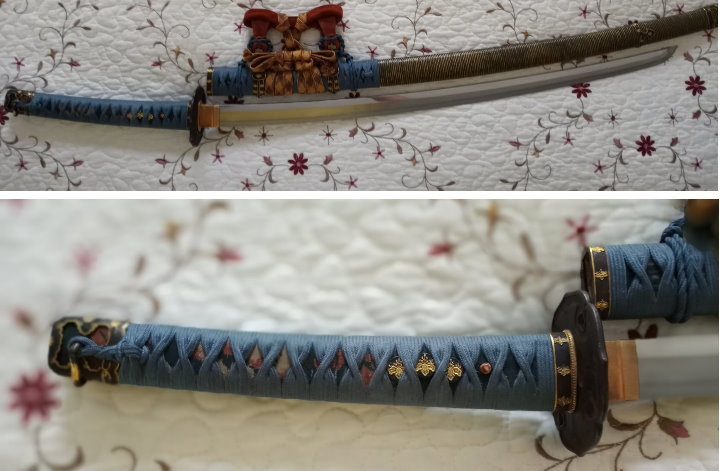
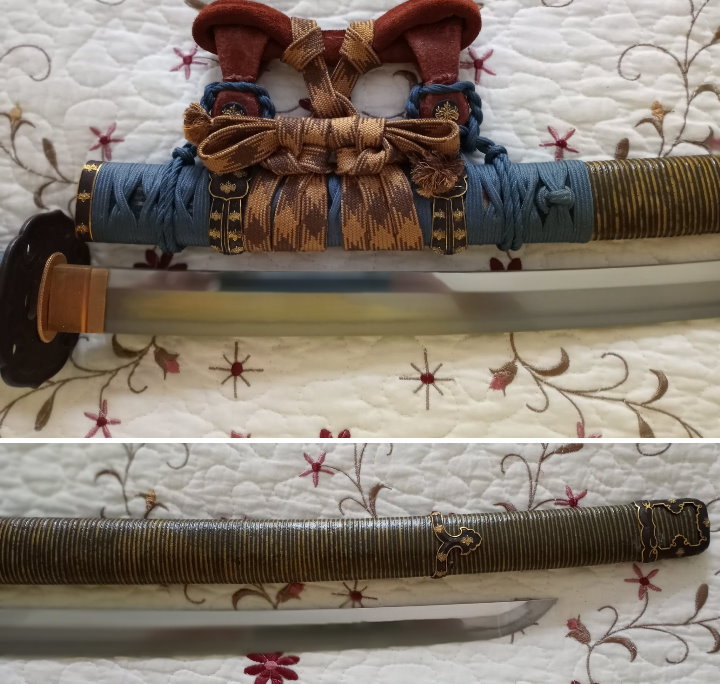
For this project there was a slight external delay, I took the liberty of having the menuki gilded then aged, and the menuki look pretty close to old originals now, but the jeweler took a little longer than I expected. I was having some other brass fittings plated/gilded, so I included these with that lot... no extra charge.
As requested by the client, I used old rayskin, and I happened to have an old original gunto eyelet for the kashira. Now all they need is a surate, or tassel loop. Here's a couple of quick snapshots of the prepped tsuka, and after the wrap. Sorry for the photo quality...

|
|
September 23, 2021 08:46:54 AM
Posted By Thomas L. Buck
|
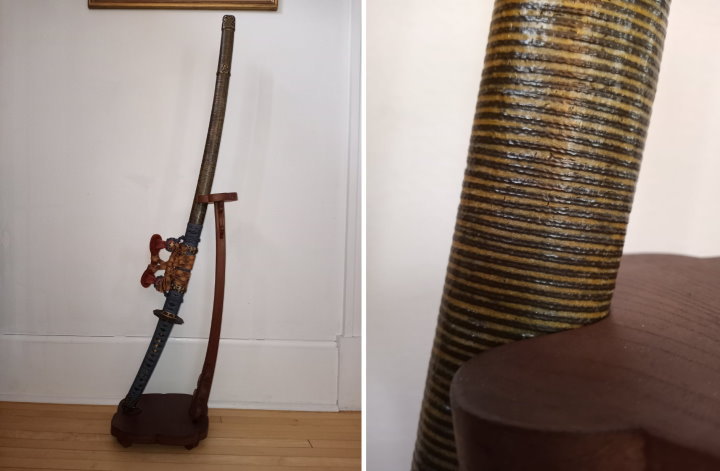
Ahead of their big event this weekend, this morning my wife, Andrea Buck, and I delivered this gift to our niece Aryana Buck and her fiance Evan Meyer (owners of Empire Coffee).
In addition to a nice two tiered hand carved sword stand, they received a 27 inch, mumei (unsigned), late Shinshinto (circa, 1850) Katana from the Mino Province in Japan.
We wish them many years of happiness together.
 

|
|
June 22, 2021 09:32:58 AM
Posted By Thomas L. Buck
|
Here's an interesting project, in the photos I finished the initial wrap, but I still have to make a few minor adjustments so everything is uniform and all the crossovers are consistent in shape and size.
Take a look at the pictures and let me know what you think. The client only had one menuki, so I rummaged around and found one similar in color and size... Can you tell which one is the replacement menuki, and is it close enough?

|
|
May 17, 2021 10:56:39 AM
Posted By Thomas L. Buck
|
|
|
|
April 22, 2020 02:42:52 PM
Posted By Thomas L. Buck
|
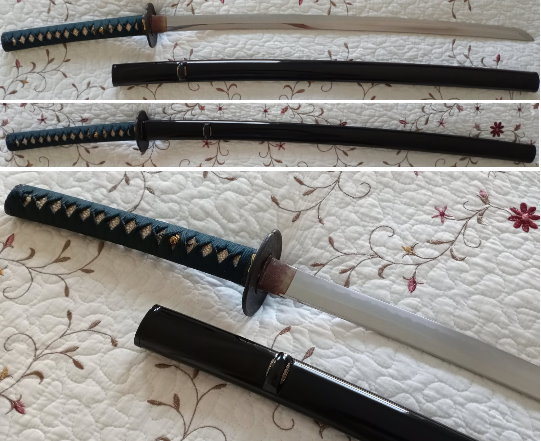
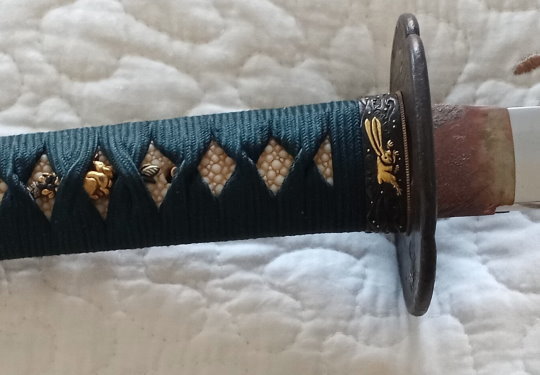
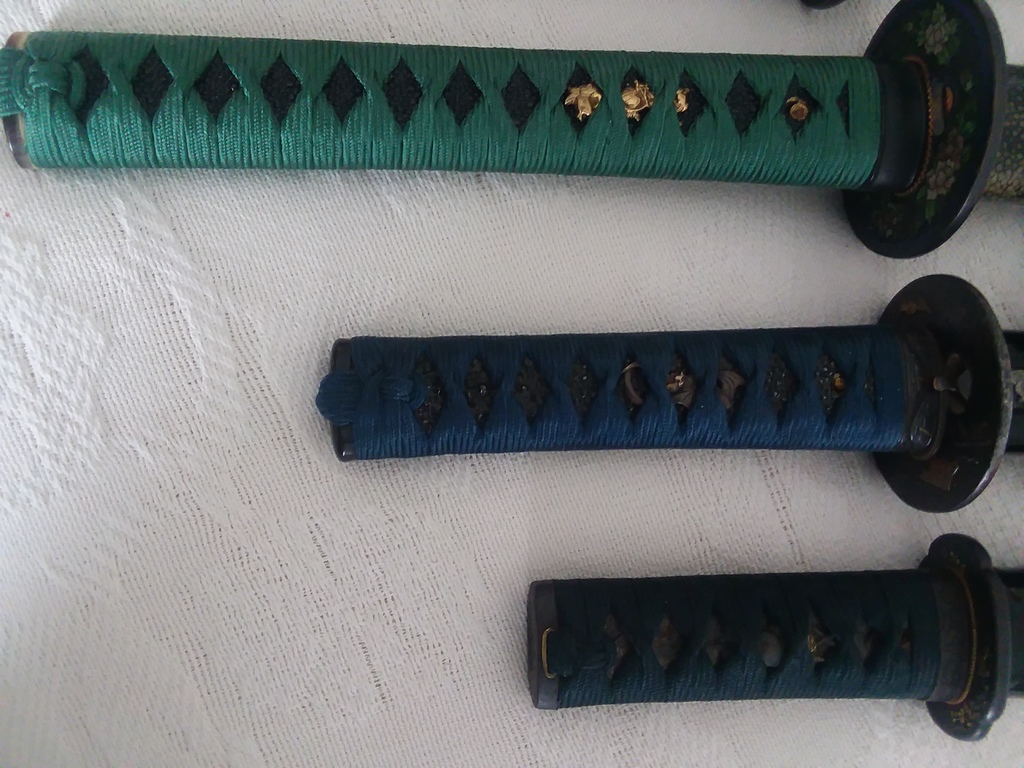
I was recently asked, "What colors work best with black rayskin?"
In general, it's a matter of taste, but personally I prefer greens, golds, and blues/teals. Here are three examples from our collection that kind of illustrate what I'm talking about...
If you can think of other colors that work with a black rayskin, please share.
|
|
August 9, 2019 06:08:31 PM
Posted By Thomas L. Buck
|
 A good friend in the sword community recently received recognition by the Japanese government for his excellent work. A good friend in the sword community recently received recognition by the Japanese government for his excellent work.
Hans Koga (formerly Hans Igelström of Sweden) has been studying the restoration and preservation of Japanese swords since 2008. After moving to Japan in 2011, he studied at a Japanese sword studio in Tokyo before moving to Kumamoto Prefecture in 2015, where he learned the technique of Higo-koshirae. Today, he works as a koshirae craftsman devoted to both production and restoration.
Read the complete story at JapanGov (The Japanese government's official web-based magazine - https://www.japan.go.jp/tomodachi/2019/ autumn2019/foj_hans.html).
|
|
August 2, 2019 08:03:22 AM
Posted By Thomas L. Buck
|
 Recently, we were given this sword... initially I believed it was simply a pre-WWII Chinese officer's sword that was made in Japan... But after some help from a friend who is a Chinese military historian, it turns out that this sword was gifted to a member of the KMT (Kou Ming Tang - Chinese Nationalist Party) by a Chinese politician named Wang Zhaoming (林文傑 - the name engraved on the first side of the blade), with wishes of "deep wisdom and profound courage " (engraved on the opposite side of the blade. Recently, we were given this sword... initially I believed it was simply a pre-WWII Chinese officer's sword that was made in Japan... But after some help from a friend who is a Chinese military historian, it turns out that this sword was gifted to a member of the KMT (Kou Ming Tang - Chinese Nationalist Party) by a Chinese politician named Wang Zhaoming (林文傑 - the name engraved on the first side of the blade), with wishes of "deep wisdom and profound courage " (engraved on the opposite side of the blade.
Wang Jingwei (Wang Ching-wei; 4 May 1883 – 10 November 1944), born as Wang Zhaoming (Wang Chao-ming), but widely known by his pen name "Jingwei", was a Chinese politician. He was initially a member of the left wing of the Kuomintang (KMT), leading a government in Wuhan in opposition to the right-wing government in Nanjing, but later became increasingly anti-communist after his efforts to collaborate with the Chinese Communist Party ended in political failure. His political orientation veered sharply to the right later in his career after he collaborated with the Japanese.
 Wang was a close associate of Sun Yat-sen for the last twenty years of Sun's life. After Sun's death in 1925 Wang engaged in a political struggle with Chiang Kai-shek for control over the Kuomintang, but lost. Wang remained inside the Kuomintang, but continued to have disagreements with Chiang until the outbreak of the Second Sino-Japanese War in 1937, after which he accepted an invitation from the Japanese Empire to form a Japanese-supported collaborationist government in Nanjing. Wang served as the head of state for this Japanese puppet government until he died, shortly before the end of World War II. Although he is still regarded as an important contributor in the Xinhai Revolution, his collaboration with Imperial Japan is a subject of academic debate, and the typical narratives often regard him as a traitor in the War of Resistance. Wang was a close associate of Sun Yat-sen for the last twenty years of Sun's life. After Sun's death in 1925 Wang engaged in a political struggle with Chiang Kai-shek for control over the Kuomintang, but lost. Wang remained inside the Kuomintang, but continued to have disagreements with Chiang until the outbreak of the Second Sino-Japanese War in 1937, after which he accepted an invitation from the Japanese Empire to form a Japanese-supported collaborationist government in Nanjing. Wang served as the head of state for this Japanese puppet government until he died, shortly before the end of World War II. Although he is still regarded as an important contributor in the Xinhai Revolution, his collaboration with Imperial Japan is a subject of academic debate, and the typical narratives often regard him as a traitor in the War of Resistance.
This is a very interesting addition to our collect, if you have any further information in regards to the history of this sword, please share. See the pictures below...


|
|
February 20, 2019 05:35:32 PM
Posted By Thomas L. Buck
|
Getting things packed for the Tampa Show.
One thing I'm really looking forward to is the Shinsa - here's the latest update:
A team of experts from the 日本刀剣保存会 (Nihon Token Hozon Kai) of Tokyo, Japan will be lead by Mr. Yoshikawa Eiichi, the son of the late Kentaro Yoshikawa, and like his father, curator of swords for the Japanese Imperial Household Agency, the Shosoin Imperial Repository, the Seikado museum collection and polisher for the Japanese Imperial Household. Swords and fittings will be examined by the team and certificates of authentication issued.
Location: Tampa Airport Marriott
https://www.southeastshowsauctions.com
Dates: March 1st - 3rd 2019
Daily Schedule: Doors open at 8:30 AM
Shinsa: 9 AM-Noon 1PM – 5PM
Q & A: 5PM – 6PM
Hope to see you there!

|
|
June 13, 2018 05:08:26 PM
Posted By Thomas L. Buck
|
Occasionally I blend colors. Here is a work in progress that's a perfect example... I received the chigai jabara maki ito last week, and with a prepped handle, I measured and began sewing the alternating colors together (purple and white). Then, after making sure everything was going according to plan, I began wrapping the tsuka.
For this project, I am wrapping the tsuka in the Iro Chigai Jabara Maki style (see: www.tsukamaki.net/tsuka_08.htm
These pics are from when I was just starting, so it may seem kind of rough and the cross overs weren't adjusted or totally secured. Because this is a "delicate" wrap that the client plans on using for practice, as mentioned, I had to stitch/secure the cross-overs to minimize their shifting). Also, on the first cross-over on the ura side, I wove it instead of the regular cross-overs.
Regardless, tell me what you think...


|
|
May 24, 2018 09:04:53 AM
Posted By Thomas L. Buck
|
Helped further a research project by some like minded investigators by lending an artifact from our private collection... Getting the photo and "thank you" letter was the highlight of my day.

|
|
December 10, 2017 11:46:08 AM
Posted By Thomas L. Buck
|
 Received a sword with some interesting mounts yesterday... Made in 1943 by "Kaneshige"; the tsuka is wrapped in more of a handachi style; the leather covered lacquered saya has square buttons on the snaps, and a stylized leather kojiri; and, silver plaque on the side that says, Received a sword with some interesting mounts yesterday... Made in 1943 by "Kaneshige"; the tsuka is wrapped in more of a handachi style; the leather covered lacquered saya has square buttons on the snaps, and a stylized leather kojiri; and, silver plaque on the side that says,
"A captured Japanese sword presented to Staff General Xiao by General Liao YaoXiang of the Nationalist Chinese Army upon his return, September of 1945."
The photo to the left is Staff General Xiao, the recipient of the sword, and the Chinese General who presented the sword, General Liao, was of great significance in the history of Chinese war against japan, as well as the internal civil war which followed WWII. You can read more about him here:
 (https://en.m.wikipedia.org/wiki/Liao_Yaoxiang)
Anyway, here are a few photos of the sword:


|
|
April 9, 2017 06:40:06 PM
Posted By Thomas L. Buck
|
|
|
|
December 28, 2016 10:00:00 PM
Posted By Thomas L. Buck
|
|
|
|
September 6, 2016 04:48:12 PM
Posted By Thomas L. Buck
|
|
|
|
|
|